I must take the time now to sincerely express my utmost gratitude to all of you miraculous people who have taken the time out of your busy lives to take a gander at the philosophical ranterings of an unknown teenage philosopher. You really have no idea how much I appreciate it. But on that note, I imagine that this blog is getting a bit preditable for the majority of it's readers; every week a new analysis of a piece of literature and how it connects to modern life... The absolute last thing that I desire to execute, and trust me on this, is to make the American period of being even more cumbersome. The aforementioned statement and the fact that I imagine reading about my life so much can get rather exasperating (this is the part where you bashfully shake your head saying, "Of course not" while all your mental script consists of is "Wow, he finally figured that out") have caused me to "kick it up a notch", as the exquisite chef Emril Lagasse says. Meditations of a Teenage Philosopher will now include a section where I post a piece of my creative writing each month for your personal reading please. The name of such a feature? "A Monthly Slice of Creative Writing." So now in addition to reading the posts, you may click on the page tab labeled "Who Wants a Slice?" and see what piece of original literature has been composed from the haphazard contents of my mind. You can eye this month's slice right here.
You now may have noticed that this post does not beckon the substantial sum of pondering that all writings on this weblog do; well, as you may have guessed I cannot permit you to leave that easily. So as to prepare for my next post that should be published some time before next weekend, I have a question for you: What is sacrifice?
Think, my good friends, or even comment if you wish, because your thoughts can save the world.

Sunday, February 27, 2011


Tuesday, February 22, 2011
Odysseus, Meet Leonardo DiCaprio
 So following Lady Gaga's domination of the Grammies with her eggxuberantly (get it?) unique arrival, the next imperative award ceremony is quickly approaching us: the prestigious Oscars. Every year, I attempt to see one movie that is nominated by the Academy (or at least a commercial for one,) but this year I had the audacity to take the complexity of my cinematic pallet into my own hands by inviting all of my friends over for a viewing of The Social Network. However, my fellows decided against this because they possessed the notion that this film would be excessively boring-go figure. But there was one Oscar-nominated movie that they all agreed to experience, and that was Christopher Nolan's psychological thriller Inception....and I must say that at the culmination of this film, I felt just as I did when I completed Mockingjay (you remember...) No film had ever taken me on the mental uphill march that this one had with its intricate quilt that interweaved complex plot and blatant, raw emotion; it was extremely evident that each moment was infused with a more-than-significant amount of thought. I am just giving you a warning: if you are planning on seeing Inception soon and do not wish to know how the yarn culminates, do not read on since I am about to spoil the entire movie within this composition. But once you are finished, my words in the post will be more than happy to greet your eyes.
 The Odyssey. Yes, that beloved epic poem composed by a blind Greek bard whose wordcraft that was utilized thousands of years ago is still taught to every freshman in America today. Through its pages, we learn about what transpires when our favorite war hero, Odysseus, does not thank the Greek god of the sea ,Poseidon, for his work in helping Odysseus win the Trojan War for the Greeks. Therefore, Poseidon and his gargantuan ego decide to make Odysseus's journey back to his homeland, the Greek city-state of Ithaka, as miserable and long as possible. In the end, it takes the man ten heart-wrenching years to reach Ithaka, where he finds that a horde of men have come into his royal palace to court his wife while ignoring the true heir to the Ithakan throne: Odysseus's son Telemakhos. Through this prolonged journey, however, Odysseus comes into contact with a very unique figure: the breathtaking sea nymph Kalypso, who holds Odysseus captive on her tropical island paradise of an island for seven years. She is saturated with ardent lust for the man and poses a very enticing offer to him as well: immortality in her tropical paradise with constant sexual attention. Odysseus, however, knows through a prophecy told to him before this life-altering moment about the horrible state that has possessed his wife and son and therefore refuses Kalypso's offer. But his decision to leave the divine paradise and attempt to reach Ithaka by boat again instead has numerous consequences, these including the endurance of another excruciating storm sent by Poseidon and the difficulty he will face in removing the suitors from the royal palace back in Ithaka. Is it then worth it for Odysseus to give up a life where his desires are constantly entertained and not a single issue troubles him except the distant thought of the family he left behind? Even this thought would be gone, since Odysseus would have to make himself completely ignorant to all memories of Ithaka if he planned to reside on the island with Kalypso forever. The real question that faces Odysseus is really if it is worth accepting ignorant bliss when an ocean of horror lies behind that veil of ignorance? Would he rather live with the knowledge that the horror lies there, or meet the horror in hopes of eradicating it? Is it better for him to live a life that gives him every pleasure in the world but one, or dedicate his life to attaining one pleasure?
The most encompassing skeleton that lies in Cobb's closet turns out to be that he has been charged with the murder of his wife, Mal, and therefore cannot return to the United States until one of his clients in able to pay the government enough money to free him of all charges. He actually did not commit the crime, but his secret lies in the fact that he might as well have. You see, the reason why Cobb knows that inception can occur is that he performed it on his wife, and the idea that he planted within her mind grew to be so powerful that it convinced her to commit suicide and blame her husband for the death. Why did Cobb perform inception on Mal? Well, it is revealed that Mal was also an extractor who was just about as excellent as her spouse, and one day the two of them decided to experiment with the idea of multiple layers of dreaming. What they discovered was that there can only be so many dreams within dreams; after delving into so many layers, one finds himself on the shores of his own subconscious, a limbo between the worlds of dreams and reality. Hours feel as if years in this place, and the couple finds that they are forced to remain in the limbo until waking up is feasible. What Cobb and Mal execute to pass the time is create a world for themselves, a bustling city with skyscrapers and any possession that the two of them could ever desire including replications of each of their childhood homes. However, Mal eventually finds herself convinced that this world is indeed reality after living in it for so long and locks this conviction deep inside of her mind; therefore when Cobb and Mal discover that they can leave the shores of subconsciousness for reality, Mal is left thinking that the shores actually are reality. Cobb's solution to this conflict is inception, the idea being inserted into Mal's mind being that her reality is not reality and everything in what she reasons is the real world is just a projection (a reflection of the human subconscious that takes the form of a person or object of some significance to the human). The way to wake oneself up from a dream is to commit suicide within that dream, and that is what Mal and Cobb then do to return to reality. There is another problem, though, when the couple wakes up: Mal finds herself in what she thinks is the real world while still being possessed by the notion that the real world is just a dream. This sinister thought makes the woman convinced of two facts: that she must commit suicide in order to reach what is truly reality, and that her husband must accompany her in this martyrdom for her idea. In order to act on the aforementioned thoughts, Mal decides on the night of her wedding anniversary to jump from a window across from the hotel room where she and Cobb usually spend the evening and to leave a note back at the couple's house that frames Cobb as Mal's killer so that he can join her in suicide. But Cobb refuses to jump, and from the dead body of Mal rises the phoenix of guilt within Mr. Cobb stemming from his thought that he was the person gave Mal the idea that murdered her.
The dilemma Walter Cobb faces could have been avoided; if he had simply accepted the shores of subconscious as reality just as his wife did, then the two of them would have lived long and pleasant lives within their own escapist universe. But would the mirth he would have received from that life outweigh the horror that would have been generated at the thought that while they two of them are living happily in the world of dreams, everybody who depended on Mr. and Mrs. Cobb in the real world are in a state of panic? Odysseus is in a similar situation: he can live a wondrous eternity saturated with pleasures galore alongside Kalypso, but with the acceptance of this life would come the realization that Odysseus's wife and son would never receive the help from the man that they so desperately need. Forget that-Penelope and Telemakhos wouldn't even be able to experience the joy of seeing the man again, plus Odysseus would also love to undergo the pleasure of seeing the two of them again once more.
So is living one's life in escapism truly better than facing reality? Well, my answer is...partly. Escapism is a marvelous method through which to contemplate reality because an escapist world is separate from reality. We each can therefore learn more about our own worlds through contemplation within an escapist world and use the thoughts generated during this experience to live better lives once we emerge from the mysterious depths of our personal universe-however, that is the most imperative component. When one submerges herself into an escapist world, she must insure that she will exit from it before the removal from reality negatively affects her actual life. NEVER can one accept an escapist universe as reality as Mal did since that can actually harm one's life, which is the inverse to what the effect of escapist contemplation should be upon a person. The rule that I established in the Super Sad True Love Story post indisputably applies here: an excess amount of a positive phenomenon is utterly and completely negative.
What are some forms of escapism that one can use to contemplate the world, you may ask? The answer is any activity that makes you feel as if you are somewhat disconnected from the preoccupations customarily generated in your life. I have recently observed that the arts and exercise are two forms that are particularly successful in achieving this escapist aura. For me, being the psychotic maniac I am, the path to the greatest escapist contemplation is the composition of the words you are reading at this very moment.
Monday, February 7, 2011
What I Wish They'd Teach Me in Science

I'm loving it.
Here are the basics: Henrietta Lacks was an African American woman who hailed from Clover,a diminutive town in Southern Virginia where her ancestors once worked as slaves. She married her cousin, Day Lacks, and had given birth to a few children when she moved to Baltimore so that Day could work at a flourishing steel manufacturing plant called Sparrow's Point. It was during the time that she was in Baltimore that Henrietta took her first trip to Johns Hopkins gynecology clinic to have the doctors investigate the pungent pain she had been feeling in her lower belly for more than a year. The "knot" inside of her, as she described it, turned out to be a malignant tumor growing on her cervix that possessed the potential to kill her. Now, at the time when this all occurred, there was a man named Dr. Richard Wesley TeLinde who was highly revered in the field of gynecology and was trying to make a huge impact on the way that cervical cancer was treated. So here's my attempt at an explanation of the exuberantly scientific-sounding theory that TeLinde was attempting to prove: Cervical cancer begins with the formation of a carcinoma, which grows on the cells that protect the surface of the cervix from potential threats. There are two types of carcinomas: ones that have gone through the outer wall of the cervix and into it (invasive carcinomas), and ones that have not (noninvasive carcinomas). Doctors at that time believed that it was a waste of time to treat noninvasive carcinomas because they thought they would not spread, while they treated invasive carcinomas vivaciously. What TeLinde wanted to do was to prove that doctors should in fact treat noninvasive carcinomas because he believed that they lead to the formation of invasive carcinomas. In order to prove this through experimentation, however, he needed cells that were extracted from and would continue to live and divide outside of a human body. Actually, many experiments that scientists of that day wanted to perform required the use of "immortal" cells, so to speak. For such specimens, TeLinde called on Dr. George Gey (and it's pronounced "Guy," for all you sixth-graders), who had been trying to find such immortal cells for some time. TeLinde began having the doctors at Johns Hopkins collect tissue samples from the cervixes of women who they treated, Henrietta being one of these women, to help Dr. Gey in his quest. Most cells died and many of people working in the Gey laboratory lost hope that these "immortal" cells would ever be found-until, of course, they saw the cells collected from Henrietta's cancer-riddled cervix. As long as they were given nutrition through a culture medium, Henrietta's cells continued to divide into a glorious infinity. Dr. Gey thought the phenomenon a miracle, and soon the cells-HeLa Cells, as they were named-began to be produced in factories around the country. One of these factories that was located an the Tuskegee institute began to ship HeLa cells to numerous scientists from all over the world for experimentation. Those cells were used for numerous advances in science throughout the years that would follow their creation, especially the revolutionary polio vaccine that saved millions of lives...Yes, everything was great and wonderful, except for one phenomenon: You see, while HeLa cells are living to this day and have existed throughout a great amount of history, the person who they were extracted from was not so fortunate.
Henrietta Lacks perished on October 4, 1951, leaving all of her children, her husband, and her family without the woman who they all depended on so immensely. She spent her last days enveloped in excruciating pain because of the influx of tumors that began to grow all over her body as her closest cousins, Margaret and Sadie, watched in horror. To add to this heartbreak, there was another aspect of this saga that was very controversial-not one person ever asked Henrietta if they could take a culture cells. Not one nurse, doctor, or even secretary murmured an iota of knowledge except for Dr. Gey, who conducted a short conversation with her that occurred near her death.
This practice demonstrates what I think is a very unfortunate habit among the human race-to use trickery in order to achieve our ambitions. Technically, the doctors at the time could use the argument that Henrietta did not say that they couldn't take a culture of her cells and use it for scientific research. However, despite its technical legality at the time, I think you could probably explain Henrietta's situation to any person in Baltimore and that person would reason that the action was not righteous in the least. A large part of my life I have refrained from telling all you about until the present moment is my interest in instrumental music. I am not the kind of musician that spends three hours a day practicing , but I still am one who loves the art form dearly and even keeps a miniature version of his instrument on his nightstand so he can see it every night before he retires (and I know how psychotic that is.) Oh, how I digress...anyway, my teacher has recently been instructing me on how to play a solo for this year's county music competition. Throughout the experience, she's always telling me to insert crescendos (a marking that indicates that one should increase in volume) or decrescendos (a marking that indicates that one should decrease in volume) into places where they are not written in the piece. She either has one of two excuses for these actions: it's either because "You're the artist," or "He [the composer] didn't say not to". I, of course being the diligent student (a.k.a. goody-goody-too-shoes) that I am, do not interrupt. In my head, though, I am think that if the composer did not write the marking, then obviously he did not want it inserted into that spot. This fact comes through common sense, right? He thought that the piece sounded perfect without the markings, so why not just leave the piece be since it was written by that man after all. But I just play the solo with all of these manufactured markings of contemporary times, hoping to get a perfect, impeccable score on my evaluation from a judge who doesn't fill out my scoring sheet in Hieroglyphics. Is that half of the problem-that we permit this deceitful manipulation to occur because it is not persecuted and ultimately aids us in achieving our ambitions? What if the composer was resurrected and saw what I was doing to his original piece? How would I feel? How would he feel? And even after writing this, do you know what's queer?
I will walk into that evaluation room on the day of the competition and still manipulate that solo so it will benefit my flawed, philosophical self.
Here are the basics: Henrietta Lacks was an African American woman who hailed from Clover,a diminutive town in Southern Virginia where her ancestors once worked as slaves. She married her cousin, Day Lacks, and had given birth to a few children when she moved to Baltimore so that Day could work at a flourishing steel manufacturing plant called Sparrow's Point. It was during the time that she was in Baltimore that Henrietta took her first trip to Johns Hopkins gynecology clinic to have the doctors investigate the pungent pain she had been feeling in her lower belly for more than a year. The "knot" inside of her, as she described it, turned out to be a malignant tumor growing on her cervix that possessed the potential to kill her. Now, at the time when this all occurred, there was a man named Dr. Richard Wesley TeLinde who was highly revered in the field of gynecology and was trying to make a huge impact on the way that cervical cancer was treated. So here's my attempt at an explanation of the exuberantly scientific-sounding theory that TeLinde was attempting to prove: Cervical cancer begins with the formation of a carcinoma, which grows on the cells that protect the surface of the cervix from potential threats. There are two types of carcinomas: ones that have gone through the outer wall of the cervix and into it (invasive carcinomas), and ones that have not (noninvasive carcinomas). Doctors at that time believed that it was a waste of time to treat noninvasive carcinomas because they thought they would not spread, while they treated invasive carcinomas vivaciously. What TeLinde wanted to do was to prove that doctors should in fact treat noninvasive carcinomas because he believed that they lead to the formation of invasive carcinomas. In order to prove this through experimentation, however, he needed cells that were extracted from and would continue to live and divide outside of a human body. Actually, many experiments that scientists of that day wanted to perform required the use of "immortal" cells, so to speak. For such specimens, TeLinde called on Dr. George Gey (and it's pronounced "Guy," for all you sixth-graders), who had been trying to find such immortal cells for some time. TeLinde began having the doctors at Johns Hopkins collect tissue samples from the cervixes of women who they treated, Henrietta being one of these women, to help Dr. Gey in his quest. Most cells died and many of people working in the Gey laboratory lost hope that these "immortal" cells would ever be found-until, of course, they saw the cells collected from Henrietta's cancer-riddled cervix. As long as they were given nutrition through a culture medium, Henrietta's cells continued to divide into a glorious infinity. Dr. Gey thought the phenomenon a miracle, and soon the cells-HeLa Cells, as they were named-began to be produced in factories around the country. One of these factories that was located an the Tuskegee institute began to ship HeLa cells to numerous scientists from all over the world for experimentation. Those cells were used for numerous advances in science throughout the years that would follow their creation, especially the revolutionary polio vaccine that saved millions of lives...Yes, everything was great and wonderful, except for one phenomenon: You see, while HeLa cells are living to this day and have existed throughout a great amount of history, the person who they were extracted from was not so fortunate.
Henrietta Lacks perished on October 4, 1951, leaving all of her children, her husband, and her family without the woman who they all depended on so immensely. She spent her last days enveloped in excruciating pain because of the influx of tumors that began to grow all over her body as her closest cousins, Margaret and Sadie, watched in horror. To add to this heartbreak, there was another aspect of this saga that was very controversial-not one person ever asked Henrietta if they could take a culture cells. Not one nurse, doctor, or even secretary murmured an iota of knowledge except for Dr. Gey, who conducted a short conversation with her that occurred near her death.
This practice demonstrates what I think is a very unfortunate habit among the human race-to use trickery in order to achieve our ambitions. Technically, the doctors at the time could use the argument that Henrietta did not say that they couldn't take a culture of her cells and use it for scientific research. However, despite its technical legality at the time, I think you could probably explain Henrietta's situation to any person in Baltimore and that person would reason that the action was not righteous in the least. A large part of my life I have refrained from telling all you about until the present moment is my interest in instrumental music. I am not the kind of musician that spends three hours a day practicing , but I still am one who loves the art form dearly and even keeps a miniature version of his instrument on his nightstand so he can see it every night before he retires (and I know how psychotic that is.) Oh, how I digress...anyway, my teacher has recently been instructing me on how to play a solo for this year's county music competition. Throughout the experience, she's always telling me to insert crescendos (a marking that indicates that one should increase in volume) or decrescendos (a marking that indicates that one should decrease in volume) into places where they are not written in the piece. She either has one of two excuses for these actions: it's either because "You're the artist," or "He [the composer] didn't say not to". I, of course being the diligent student (a.k.a. goody-goody-too-shoes) that I am, do not interrupt. In my head, though, I am think that if the composer did not write the marking, then obviously he did not want it inserted into that spot. This fact comes through common sense, right? He thought that the piece sounded perfect without the markings, so why not just leave the piece be since it was written by that man after all. But I just play the solo with all of these manufactured markings of contemporary times, hoping to get a perfect, impeccable score on my evaluation from a judge who doesn't fill out my scoring sheet in Hieroglyphics. Is that half of the problem-that we permit this deceitful manipulation to occur because it is not persecuted and ultimately aids us in achieving our ambitions? What if the composer was resurrected and saw what I was doing to his original piece? How would I feel? How would he feel? And even after writing this, do you know what's queer?
I will walk into that evaluation room on the day of the competition and still manipulate that solo so it will benefit my flawed, philosophical self.
Tuesday, January 18, 2011
A Super (Hopefully) Not-Sad True Post
 Let me share a precious, childhood memory with you: when I was nine, my mother and I were fastidiously baking oatmeal-raisin cookies for our annual Christmas party at our aunt's. Oh...now that I ponder about it, it was actually she was was baking so fastidiously; I was just there to see the incredible event that occurred when I mixed all of the ingredients together into a gooey and oh-so-delectable-looking batter. Aside from that, I also desperately wanted to be my mom's sue chef because I had a craving, a mad desire of sorts, to smell the liquid contained in that miniature bottle with the word "Vanilla" taped onto it. Man, that rich and luscious odor that I was sure heaven would smell like when I reached it in, the exquisite fumes that made my heart swell with joy. There was really nothing like it...as there was nothing like my mother's face when I accidentally poured half the contents of that bottle into the bowl.
The batter, now soiled by an excess of the brown elixir, had to be thrown out, and the sue chef exiled from the kitchen so that the next baking session would transpire at the speed of light. Now, let me share with you another, more recent memory: as I was watching the Golden Globes on Sunday, I noticed something else than the host's malignant habit of seriously insulting every person in the room. I noticed that even though the award show possessed a diverse array of actors, it did not possess a diverse array of creativity, and I'm not talking about how the acts of most presenters were as original as horizontal blinds. You see, many of the characteristics possessed by the new NBC TV shows whose commercials were aired during the broadcast of the awards and some the award recipients as well were the equivalent: violence, the effects of violence (as in the works of lawyers), and a basis on an actual event. These included a horrifically cliche NBC drama about a superhero of some kind called The Cape, a critically acclaimed and Golden-Globe-hoarding movie about Mark Zuckerberg called The Social Network (which is on my bucket-list of films I have to see,) another new NBC law drama starring Kathy Bates called Harry's Law, and an optimistic film about a monarch with a stutter called The King's Speech. Now, there's nothing chronically wrong with any of these pieces of entertainment, but there definitely is some kind of conflict
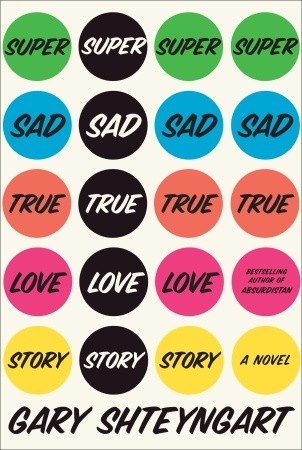
But first I must inform you of the novel whose words my eyes have been deciphering for the last two weeks at a hopelessly incremental rate. It is the satirical work Super Sad True Love Story by Gary Shteyngart that describes both an America riddled by the unforeseen difficulties of an overly technological age and a man who's trying to reap its benefits while enjoying it as well. That man is Lenny Abramov, who at the beginning of this novel is on a business trip in Rome for his employer, Post-Human Services. He is a thirty-nine-year-old, slightly overweight man who has a bald spot the shape of Ohio and believes that a life that ends in death is not worth living. His job in Rome is to find High Net Worth Individuals, or people who can both financially and physically afford for Post-Human Services to make them immortal through a series of costly operations. They must desire to live forever too, of course, but Lenny's real problem is finding anyone with the qualifications. While on this trip, he also meets the love of his life, Eunice Park-a Korean woman who is in the know of the latest technology but also possesses the burden of being a part of a crisis-ridden family. Eunice, feeling as most twenty-four-year-olds would, doesn't have any more than an iota of affection for Lenny, but Lenny is persistent. When he is on the plane back from Rome he makes a promise to himself to passionately love her, but that promise is momentarily put into the back burner of his mind when he sees that Post-Human Services has been filled with a completely new cast of young, hip, and fit employees. He has become an outcast, and it is only with the help of his caring and eternally young boss, Joshie, that he is accepted again.
Lenny's America is one where around every one's neck is a pebble-sized device called an äppärät that can perform any task from recording video to informing you of the financial status of every person you come into contact with at any moment in the day. Almost every person in the world is connected on a social network called GlobalTeens that lets them chat acronyms like JBF (just butt f#!@ing) to each other. And last but not least, this futuristic America is one where the controversial president Rubenstein of the Bi-Partisan Party (because that is the only political party in Lenny's America) has launched an attack on Venezuela that has made the U.S. the black sheep of the world, not to mention unleash a deluge of antisemitism. The American debt to China is so horrible that now every dollar in yuan-pegged, and the American Restoration Authority handles the immigration issue with a benevolent otter whose catch-phrase is "Howdy, Pad'ner." This America, as the current American entertainment industry does, struggles under the conflict of positive ideas blown into exuberant proportion: a snare that all too many systems can become engulfed in. But first I must inform you of the novel whose words my eyes have been deciphering for the last two weeks at a hopelessly incremental rate. It is the satirical work Super Sad True Love Story by Gary Shteyngart that describes both an America riddled by the unforeseen difficulties of an overly technological age and a man who's trying to reap its benefits while enjoying it as well. That man is Lenny Abramov, who at the beginning of this novel is on a business trip in Rome for his employer, Post-Human Services. He is a thirty-nine-year-old, slightly overweight man who has a bald spot the shape of Ohio and believes that a life that ends in death is not worth living. His job in Rome is to find High Net Worth Individuals, or people who can both financially and physically afford for Post-Human Services to make them immortal through a series of costly operations. They must desire to live forever too, of course, but Lenny's real problem is finding anyone with the qualifications. While on this trip, he also meets the love of his life, Eunice Park-a Korean woman who is in the know of the latest technology but also possesses the burden of being a part of a crisis-ridden family. Eunice, feeling as most twenty-four-year-olds would, doesn't have any more than an iota of affection for Lenny, but Lenny is persistent. When he is on the plane back from Rome he makes a promise to himself to passionately love her, but that promise is momentarily put into the back burner of his mind when he sees that Post-Human Services has been filled with a completely new cast of young, hip, and fit employees. He has become an outcast, and it is only with the help of his caring and eternally young boss, Joshie, that he is accepted again.
One of the earliest and best-remembered instances when a true story was converted into an award-winning piece of entertainment was The Sound of Music, which still possesses a well-deserved spot in the American cinema canon. Action movies involving super heroes have been a hallmark of the cinema; Richard Donner's Superman of 1978 featured the classic features of fighting to all odds against "The Bad Guys" and a studly protagonist that ends up with a woman who is randomly weaved into the plot. And as for television shows featuring the over-dramatized inner workings of law firms? The one that is probably the most prominent in memory is NBC's Law and Order, which premiered in 1990 and spawned about one thousand other legal dramas. Now all of these films and television series were appealing and creative when they were born, but after an exuberant amount of films and television series that use those same ideas in alternate stories have been released, the ideas aren't that creative anymore. They are old, overused, and make the entertainment industry travel in a cumbersomely cyclic pattern that causes some Americans to lose interest. Well, some is the key word in that phrase; most Americans treat every new copy-cat film or series with the same enthusiasm as they treated the original with. Others are so frustrated and exasperated that they just decide to immerse themselves in the "entertainment" anyway, ignoring their feeling that each each of these works of the screen is just an extension of a super-sized, original notion.
So what do I hope all of us can take away from this comparison? Original, marvelous, and creative ideas are absolutely excellent when they are moderately used, but that is not the case when these same ideas are blown into a ridiculous proportion. We must limit how we use innovation and creativity, for too much of a good thing is ultimately bad. Don't pour the whole bottle of exquisitely-smelling vanilla into the bowl-just a teaspoon is all that is necessary to make those oatmeal cookies be the best-tasting batch at the Christmas Party. Don't permit the president to culminate the State of the Union address with a cordial but inappropriate "TTYL." Don't be entertained by the same species of movie that your one-toothed great grandpa was enthusiastic about when he had a full set of pearly-whites and a mop of rich, amber hair to go with it. For in the end, the majority is who can choose whether a trend will continue and die, and it is our duty to viciously care about doing so.
Saturday, January 1, 2011
To Kill a Mockingjay
 Welcome to 2011, everybody! Now, I could go on and on right now about how my New Year's Eve went and the horror I faced when watching Ke$ha reveal her New Year's Resolution to Ryan Seacrest, but I will not digress:
 The plot: Katniss Everdeen has after narrowly escaping her death once again in the Hunger Games found a safe refuge: District Thirteen, a place that was once thought to be destroyed by the Capitol at the denouement of the first civil war in Panem. And not only did 13 rescue Katniss, Beetee, and Finnick (all former victors who participated in the Quarter Quell with Katniss) from the arena, but they also welcomed all of the survivors of the Capitol's bombing of District 12 into their midst. This attack occurred when Katniss executed a cumulative act of defiance to the Capitol by blowing up the force field that surrounded the Quarter Quell arena. The good news: Prim, Katniss's sister, Katniss's mother, and Gale, Katniss's hunting partner/lover, all survived the chaos. The bad news: Peeta, Katniss's other lover and companion throughout the games, was captured by the Capitol before District Thirteen's forces could get to him in the arena. However, the Capitol has other problems than Katniss escaping from their clutches-because of Katniss's public showing of rebellion, most of the districts are now participating in another civil war against their government as well. Within a few days, the rebels leaders in 13 tell Katniss of her role in this war: to be the poster girl of the rebel cause, to be the Mockingjay that unites all of the districts so that their oppressor can be brought down to a horrible death. And eventually, she agrees.
So what makes this book a masterpiece, you may ask? Well, you would think that District 13 is the ultimate "good side" of Panem with goodwill the driving force in government and leaders who are selfless and not power-hungry, but that is not true. Just as the Capitol used Katniss and other teenagers from the districts as puppets to insure district subordination to the Capitol, 13 does more than make Katniss a poster girl-they make her their own puppet that gathers support from all of the districts for the rebel cause. She is dressed in sleek armor that makes her look similar to a Mockingjay and remade by her prep-team all in order to make her message more poignant. When she actually ventures into the field of battle, she and her "squad" are directed towards areas of less vigorous fighting so that she isn't hurt and the camera team that always trails behind her is able to record enough footage for substantial propaganda. And then there is the leader of District 13: President Coin, an immensely shrewd woman who really only cares about Katniss when it comes to her ability to act as her puppet, the Mockingjay. It becomes clear that the only reason she wants Katniss alive is to support the rebels when she sends a homicidal Peeta, whose mind has been twisted by the Capitol to think that Katniss is an evil mutt who needs to be murdered, to be a part of Katniss's squadron in the Captitol invasion at the end of the novel. Coin has reasons that if Katniss is killed, the rebels will have a martyr to fight for when they invade the City Circle, the Panem equivalent of our Capitol Building. The ambiguity of Coin is further proved when (SPOILER WARNING) after the rebels prevail in taking the City Circle, she suggests having a final Hunger Games with the children of Capitol officials so that the people of the districts could satisfy their need for revenge against their former government. Katniss realizes this, and at the end of the story she commits one final act of revolution not against the Capitol, not against District 13, but against evil and moral ambiguity itself. That is why this book is so amazing-good and evil is not so blatantly presented to us here as it is in other book series, you must look deeper within the literary world created by the words to see it. There are about fifty thousand morals we can take away from this novel, but the one that I have just spent about half a paragraph explaining is the most effective in the world today. So for all of you who find yourself in a situation where you must choose between two opposing sides, just know this: just because a force is opposing evil does not mean that the force is good, it just means that it has something against the evil force. You can only decide what good and evil are, and I pray that all of you think that good does not include anyone innocent, anyone innocent, losing their lives, which is yet another lesson learned from Mockingjay. The only exception to this is if that death will save the lives of many more innocent people, but still, one should always try to get tasks accomplish with the least losses of life as possible. It is very easy to share peoples' aggression and join them in supporting radical actions. Many times the aggression is very justifiable and the creators of the aggression were only victims of circumstance, but don't let your sympathy towards them transform into a hatred towards other people-that is how many destructive situations that can be avoided transpire. If all who can internalize this reasoning do so, then we will live in an ultimately peaceful world with only minor skirmishes here and there that can be feasibly expunged.
So now I will enjoy my last two days of Christmas Vacation with some banana bread I just baked and the writing of my novel. Oh, and if you wanted to see what Ke$ha's resolution was, click here, but trust me, you really don't. Really.
Subscribe to:
Posts (Atom)