Showing posts with label Fantasy/Sci-Fi. Show all posts

Friday, March 29, 2013

Awareness Shouldn't Be a Miracle

The Age of Miracles
Check out Goodreads page here.
Check out Shelfari page here.
Let's think of everything happening in our world today. A civil war tearing apart Syria, the Supreme Court deciding who has the right to no-strings-attached love, Russia becoming more authoritarian...there's quite a bit to go down in the history books. However, picture yourself in fifty years. If someone asks you what you remember about the Supreme Court's decision on gay marriage, will it be the court proceedings of each individual day that you remember? Or will it be how your grandmother almost threw a plastic spoon at your brother in a heated debate concerning the topic?
     I think the latter.
     In Karen Thomson Walker's The Age of Miracles, the turning of Earth on its axis slows day to day, causing mammoth environmental changes. At first thought, one would probably reason that our main character, twelve-year-old Julia, records a significant amount about how days progressively get longer and the effects on wildlife and such (birds dying, ecosystems breaking down, the like). But surprisingly, a much larger deal of the book has to do with ways in which, parallel to Earth's progressive change, Julia's life progressively changes. When her best friend moves away to a Mormon retreat dedicated to waiting out the apocalypse, said friend promptly forgets Julia. When Julia's mother becomes anal about collecting foodstuffs, her father begins an affair with the local hippie. Events such as these compose a much larger ratio of the book than information concerning the scientific portion of this "age." To a historian, such a trend is a complete and utter waste of time. To the average human being, it is the art of living.
     Now, it can definitely be said that many more people are aware of the oncoming Supreme Court decision mentioned above than the Syrian Civil War or Russian Authoritarianism. Why? Well, what subject is most bound to come up at the family dinner table? What phenomenon is most likely to cause dissent in the American family? What phenomenon is most likely to affect American individuals?
    The Supreme Court decision, obviously.
    But the unfortunate fact is that the Syrian Civil War and Russian Authoritarianism are just as if not more important than the Supreme Court's impending decision. Syrian families have been forced to live in caves for the simple protection of their lives (more info). Russian activists are being unjustly persecuted under Putin's regime (more info). However, these topics aren't easily grasped by the American public because they don't apply very much to them--but does that mean we shouldn't care?
     Absolutely not. America has a role in the world, and that role demands that we at least keep ourselves aware of international human rights violations. Even a simple statement of "We are here for you and wish you the best" is better than the ambivalent response we have now. Moreover, those of us that who are informed have a responsibility to the world, and that responsibility is to make these imperative phenomena applicable to our fellow Americans. Bring it up at the dinner table. Keep it in the awareness of our peers. Isn't penalization of Russian Activists somewhat similar to the Patriot Act? And if we were in the same situation as those Syrian families, wouldn't we find a cave to shelter our families in as well? We are all human--it's just haphazard groupings of letters called nationalities that differentiate us.
     And most importantly, if we don't address these issues now, we will be forced to do so when they become too applicable for comfort. Remember, the world is a dreadfully small place. 

Saturday, August 11, 2012

Why Politicians Suck: Part One

     It's election year. That means many a debate on the the television, many an argument at the kitchen table, and many a politics-obsessed page in the newspaper. Eventually, the American citizen is surrounded by constant notifications of who their political savior is, who will make their lives great and reduce taxes and reduce debt and stop terrorists and buy you a unicorn that poops diamonds. I, personally, am heavily dreading this time period precisely because unicorns don't poop diamonds, and the other things aren't too probable either. To put it frankly, everyone sucks. Why so? one may ask. It is, the way I see it, because of two heavily interrelated reasons:
  1. To run for any position of high office, you have to be filthy, stinkin' rich. 
  2. We only have two parties with heavy influence. 
Nineteen Eighty-Four
See Goodreads page here.
See Shelfari page here.
     And why not look at George Orwell's 1984 for some support on this one, eh?
     Winston Smith is trying to navigate through life in an oppressive, totalitarian government. The oppressive, totalitarian ruler is a figure named Big Brother who controls every aspect of life, as represented in his motto, "Big Brother is Watching You." Winston, being a lower party member--and therefore allowed by Big Brother to have a moderate amount of intelligence--feels trapped in a world with no outlet. He knows how truly twisted Big Brother's government is. He at times feels like screaming profanity at the top of his lungs, but cannot because of the telescreen (or a stalkerish window through which Big Brother can see his every action) remarkably adorned to a wall of his living room. There are also other Big-Brother-enforced social groups in Winston's world, among them proles and Upper Party Members. Proles are the Proletariat, or working class, who are herded into only certain areas of cities and forced to do only the most menial labor. Like animals, which is basically what Big Brother makes them viewed as. On the other hand, Upper Party members are those with the most comfortable houses, those allowed by Big Brother to have the most intelligence, those who can even shut their telescreens off as they desire.
       Talk about stratification, eh? And stratification is exactly we get because politicians suck. It's going to take me a while to tell you why, but stick with me, and we'll get there.
       Since we only have two parties with significant influence, all smaller parties and their candidates--all the Winston Smiths, if Mr. Smith would contemplate entering politics--are swallowed into them. The Republican and Democratic parties in act very similar to the single, ruling party of Winston's world, the party of which Big Brother is the head: Ingsoc. You see, these obnoxiously large parties swallow the smaller ones and force all the smaller candidates into adopting their same old ideals.
     These parties also make the smaller candidates adopt the same old corrupt, money-making practices like lobbyism. What is the goal of this corruption, what is the "greater good" the politicians serve by destroying the integrity of the American system? Accelerating their political careers, of course. If they're running for high office, they need money to pay for career-accelerating phenomena like television advertisements to compete with....
     All the other politicians who are filthy, stinkin' rich and can use it!
      "And can use it" is a huge aspect of the sentence above. For if the wealthy politicians were rich, but could not use their savings funds to ensure publicity, the playing field would be a lot more even. In other words, the need for lobbyism and corrupt, under-the-table deals would decrease significantly. However, this is not the case. This is not the case in the slightest. Instead, the American governmental system has made it so that a person with a lower income must participate in the same old illegal, money-grabbing activities to be considered for a major spot in national politics. And you know what makes it even better? Even better?  The already-wealthy politicians keep participating in the same old illegal, money-grabbing activities to get an edge over their already-wealthy competitors. Excellent!
    So in conclusion, we have a system where there is a huge gap between politicians in high office and the rest of us--politicians in high office are filthy, stinkin' rich whether they started out that way or got that way  through illegal, money-grabbing activities, while the majority of the American population is still middle or lower class. The two parties with heavy influence ensure that gap by being in charge of the American government, with no significant competition but each other--remember, candidates of smaller parties are forced to buddy up with them in order to achieve any high office.
     If a politician is reading this and thinks himself or herself to be an exception to what I'm saying, please comment about how are. It would make my year.     

Sunday, April 8, 2012

The Imperfect Project Glass

I'm sure a great deal of you have read George Orwell's masterwork, 1984. The novel does an amazing job of scaring the shit out of each one of its readers, whether with a totalitarian government, rampant censorship, or the idea of no privacy. One can specifically remember that said state of privacy is predominantly achieved  through use of the ever-present telescreen, a device that tracks your every action. Our main character, Winston Smith, lives with the constant fear that the police will abduct him after his telescreen senses a rebellious action. Tracks your every action...makes a lack of privacy...well, why doesn't everyone take a look at this.

And I wonder who finds this to be utterly frightening. I see the world as a place of individual existences fragmented by some sense of greater community. When we are lonely or in need of aid is when we reach out to that larger community, but most problems are predominantly solved within the mental realm of oneself-when was the last time you needed help deciding which bathroom stall to use, or even simpler, when to move your head this way or that? At the beginning of evolution, the rudimentary primates we once were fought alone for the existence of their respective selves, and had the sole responsibility of making decisions in the interest of their survival. A wrong decision made the difference between life or death. Were those primates able to automatically ask a gps system where food was located? Did the eventual location of edible grass mean an ecstatic, facebook status?
          No.
See Goodreads page here.
See Shelfari page here.
          Previously, I've had absolutely no problem with the Facebook, GPS, Twitter, Drawsomething, Temple Run, Facetime, or whatever services that bless our computers and iPhones. This is because, although these phenomena do encourage a lapse in individual thinking, they are for the most part not as convenient as our own craniums. This new "Project Glass" is the exact opposite-more convenient than our brains. Its creators must reason that there can't be a problem when it will just make all of humanity more efficient. People will have more time to accomplish beneficial tasks such as community service just because more trivial tasks will take less time. 
            No.
          Efficiency may increase, but the possibility of technology failing us has too many consequences. If you're convinced that such failure is an impossibility, just think of how the Titanic was an unsinkable, "ship of dreams." Ask the thousands of individuals who perished, and they won't tell you it was so dreamy.
          No doubt is there that the technology insinuated by this video will deform us into beings incapable of complex reasoning. Great ideas are customarily found while searching for something else, but if one finds something else first, that great idea will never have its time in the sun. Should technology fail us, no one will be capable of devising some way to deal with the massive hole in human function. 
          Comparatively, Orwell's dystopia might be desirable. 

Thursday, December 29, 2011

Some Subtle Advice

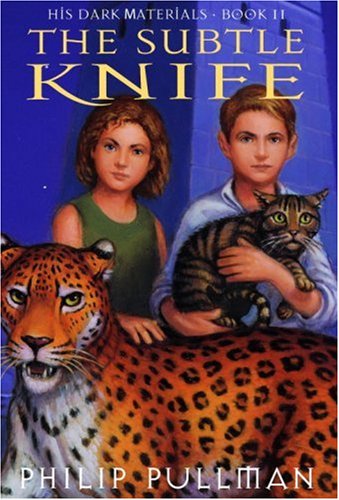
The Subtle Knife (His Dark Materials, #2)
Read Goodreads page here.
Read Shelfari page here.
I had read Phillip Pullman's The Golden Compass (or Northern Lights, for you Brits out there) when I was in sixth grade. Even at this time, I aware that many Christian groups slayed the book because of its antagonist, the Magisterium, supposedly having great similarities to Christian churches. Pullman describes the Magisterium   as capable of using both murder and spiritual murder to achieve what it desires-its main activist, Mrs. Coulter, has a certain affinity for killing others, and the organization establishes a camp of sorts where children are mechanically separated from their souls. Being a child with copious respect for authority, I decided not to continue with Pullman's His Dark Materials trilogy after Golden Compass. Time has given me a more rebellious streak, however.
      And because of that rebellious streak, I have been able to come  a conclusion: As far as the second book of his trilogy, The Subtle Knife, is concerned, His Dark Materials does not concern modern Christianity in any manner whatsoever. It deals with something else entirely
     But first, the plot: Lyra Belacqua has done a hell of a lot in her twelve years on Earth. She's helped armored bear Iorek Byrnison attain his rightful place on the throne of Svalbard Island, flown over the frozen North with aeronaut Lee Scoresby, escaped near capture by the Magisterium, and walked into another world by means of a window her Uncle Asriel forged. Said window has transported her to the world of Cittágaze, where amorphous beings called Specters haunt the streets, stealing the souls of humans below (they almost resemble dementors from Potter). Here is also where she meets Will Parry, who happens upon Cittágaze by chance after fleeing from our own world. Together, they find themselves in the middle of the greatest war ever fought, a war described by explorer Stanislaus Grumman as such:
"There are two great powers, and they've been fighting since time began. Every advance in human life, every scrap of knowledge and wisdom and decency we have has been torn by one side from the teeth of the other. Every little increase in human freedom has been fought over ferociously between those who want us to know more and be wiser and stronger, and those who want us to obey and be humble and submit."
       Many claim that "those who  want us to obey and be humble and submit" are the Christian churches. As you may imagine, there are multiple problems with this proposition, the first being that if a Church simply wants its followers to "obey and be humble and submit", why in God's name would one defend it so? Keep in mind that if this was all humanity ever did, I'd probably be learning how to hunt rather than use logarithms (I honestly can't decide which is more fun...). Yes, I'll agree that churches did make their followers obey and be humble and submit  for an epoch in history, but that was when Charlemagne, Galileo, Newton, and Copernicus lived, not Pullman and Einstein. That was more than a century ago. Additionally, the Protestant denominations openly supported science and other "heretical" phenomena during the Scientific Revolution, when the aforementioned oppression was most apparent.
      No...a force that wants its people to obey and be humble and submit would look more like this.


       Yes, Totalitarian  Rule.
       Rule where information (as in this case, the concentration camps where thousands of Jewish, Catholic, and disabled individuals perish each day) is held from the people at all costs. Such is a society where insubordination to the ruling power means death or an experience just as pleasurable as death. Such is a society where opinions contrary to the reigning are silenced in the most barbaric way possible-burning the papers that carry them. In modern times, quite a few countries in the Middle East still hold to this form of government or a variation of it. China and other Communist states also by some measure participate in such oppression.
     Additionally, a war between these forces does not just occur in the political world. Many people hold the belief that if certain knowledge does not exist, the problems that said knowledge concerns do not exist as well. Some do not read the newspaper each day to attain an ignorant mirth. "No news is good news." Well, that is not the point of life. The point is to acknowledge that there are problems in the world, whether they concern you or not, and try to live as happily as possible within their limitations. Pigheaded it is to block the true problems of the world from one's mind, because even in your little microcosm of earth, problems will still exist....smaller problems on top of the haunting knowledge that the larger problems indeed exist
     Problems will exist in the world of obeying and humbling and submitting, so it is better to know more and be wiser and stronger.


Tuesday, February 22, 2011

Odysseus, Meet Leonardo DiCaprio

So following Lady Gaga's domination of the Grammies with her eggxuberantly (get it?) unique arrival, the next imperative award ceremony is quickly approaching us: the prestigious Oscars. Every year, I attempt to see one movie that is nominated by the Academy (or at least a commercial for one,) but this year I had the audacity to take the complexity of my cinematic pallet into my own hands by inviting all of my friends over for a viewing of The Social Network. However, my fellows decided against this because they possessed the notion that this film would be excessively boring-go figure. But there was one Oscar-nominated movie that they all agreed to experience, and that was Christopher Nolan's psychological thriller Inception....and I must say that at the culmination of this film, I felt just as I did when I completed Mockingjay (you remember...) No film had ever taken me on the mental uphill march that this one had with its intricate quilt that interweaved complex plot and blatant, raw emotion; it was extremely evident that each moment was infused with a more-than-significant amount of thought. I am just giving you a warning: if you are planning on seeing Inception soon and do not wish to know how the yarn culminates, do not read on since I am about to spoil the entire movie within this composition. But once you are finished, my words in the post will be more than happy to greet your eyes. 
     Inception follows the adventures of extractors, or people who enter one's dream so that they can extract some piece of significant information that is hidden within his mind. The method by which the extractors perform this feat is by inserting themselves into the human subconscious constant cycle of creation that occurs repetitively when  humans  are dreaming. This allows them to actually create the dream, therefore determining the dreamer's place within it and allowing themselves to steal that imperative information from the dreamer's mind. Walter Cobb and his fellows are the most proficient people in the art of extraction, but Mr. Cobb has a secret that only a new architect (the part of the extraction team that forges the dream) that he takes under his wing discovers, a secret that can put any person who enters a dream with Cobb in immediate danger. This secret plays an enormous part in Cobb's decision to undertake a new case in which extraction is not what is desired; instead, the client in question desires the action of inception to be performed. Inception is the planting of a notion within some one's mind, a notion that can be so rudimentary yet simultaneously so powerful that it can have the potential to completely alter the course of a person's life. The way inception is executed is by planting stimuli within dreams so that the subject person will formulate the idea himself; the notion will not have any effect on the subject's mind if the subject is not the person who discovers it. This requires multiple layers of dreaming-dreams within dreams-and in order for this phenomenon to occur, the architect must design multiple dreams. So, you may ask curiously, what is Cobb's secret? I will unfortunately have to be the idiot who keeps you perched on the edge of your seat while I talk about...
     The Odyssey.  Yes, that beloved epic poem composed by a blind Greek bard whose wordcraft that was utilized thousands of years ago is still taught to every freshman in America today. Through its pages, we learn about what transpires when our favorite war hero, Odysseus, does not thank the Greek god of the sea ,Poseidon, for his work in helping Odysseus win the Trojan War for the Greeks. Therefore, Poseidon and his gargantuan ego decide to make Odysseus's journey back to his homeland, the Greek city-state of Ithaka, as miserable and long as possible. In the end, it takes the man ten heart-wrenching years to reach Ithaka, where he finds that a horde of men have come into his royal palace to court his wife while ignoring the true heir to the Ithakan throne: Odysseus's son Telemakhos. Through this prolonged journey, however, Odysseus comes into contact with a very unique figure: the breathtaking sea nymph Kalypso, who holds  Odysseus captive on her tropical island paradise of an island for seven years. She is saturated with ardent lust for the man and poses a very enticing offer to him as well: immortality in her tropical paradise with constant sexual attention. Odysseus, however, knows through a prophecy told to him before this life-altering moment about the horrible state that has possessed his wife and son and therefore refuses Kalypso's offer. But his decision to leave the divine paradise and attempt to reach Ithaka by boat again instead has numerous consequences, these including the endurance of another excruciating storm sent by Poseidon and the difficulty he will face in removing the suitors from the royal palace back in Ithaka. Is it then worth it for Odysseus to give up a life where his desires are constantly entertained and not a single issue troubles him except the distant thought of the family he left behind? Even this thought would be gone, since Odysseus would have to make himself completely ignorant to all memories of Ithaka if he planned to reside on the island with Kalypso forever. The real question that faces Odysseus is really if it is worth accepting ignorant bliss when an ocean of horror lies behind that veil of ignorance? Would he rather live with the knowledge that the horror lies there, or meet the horror in hopes of eradicating it? Is it better for him to live a life that gives him every pleasure in the world but one, or dedicate his life to attaining one pleasure?
     The most encompassing skeleton that lies in Cobb's closet turns out to be that he has been charged with the murder of his wife, Mal, and therefore cannot return to the United States until one of his clients in able to pay the government enough money to free him of all charges. He actually did not commit the crime, but his secret lies in the fact that he might as well have. You see, the reason why Cobb knows that inception can occur is that he performed it on his wife, and the idea that he planted within her mind grew to be so powerful that it convinced her to commit suicide and blame her husband for the death. Why did Cobb perform inception on Mal? Well, it is revealed that Mal was also an extractor who was just about as excellent as her spouse, and one day the two of them decided to experiment with the idea of multiple layers of dreaming. What they discovered was that there can only be so many dreams within dreams; after delving into so many layers, one finds himself on the shores of his own subconscious, a limbo between the worlds of dreams and reality. Hours feel as if years in this place, and the couple finds that they are forced to remain in the limbo until waking up is feasible. What Cobb and Mal execute to pass the time is create a world for themselves, a bustling city with skyscrapers and any possession that the two of them could ever desire including replications of each of their childhood homes. However, Mal eventually finds herself convinced that this world is indeed reality after living in it for so long and locks this conviction deep inside of her mind; therefore when Cobb and Mal  discover that they can leave the shores of subconsciousness for reality, Mal is left thinking that the shores actually are reality. Cobb's solution to this conflict is inception, the idea being inserted into Mal's mind being that her reality is not reality and everything in what she reasons is the real world is just a projection (a reflection of the human subconscious that takes the form of a person or object of some significance to the human). The way to wake oneself up from a dream is to commit suicide within that dream, and that is what Mal and Cobb then do to return to reality. There is another problem, though, when the couple wakes up: Mal finds herself in what she thinks is the real world while still being possessed by the notion that the real world is just a dream. This sinister thought makes the woman convinced of two facts: that she must commit suicide in order to reach what is truly reality, and that her husband must accompany her in this martyrdom for her idea. In order to act on the aforementioned thoughts, Mal decides on the night of her wedding anniversary to jump from a window across from the hotel room where she and Cobb usually spend the evening and to leave a note back at the couple's house that frames Cobb as Mal's killer so that he can join her in suicide. But Cobb refuses to jump, and from the dead body of Mal rises the phoenix of guilt within Mr. Cobb stemming from his thought that he was the person gave Mal the idea that murdered her.
      The dilemma Walter Cobb faces could have been avoided; if he had simply accepted the shores of subconscious as reality just as his wife did, then the two of them would have lived long and pleasant lives within their own escapist universe. But would the mirth he would have received from that life outweigh the horror that would have been generated at the thought that while they two of them are living happily in the world of dreams, everybody who depended on Mr. and Mrs. Cobb in the real world are in a state of panic?  Odysseus is in a similar situation: he can live a wondrous eternity saturated with pleasures galore alongside Kalypso, but with the acceptance of this life would come the realization that Odysseus's wife and son would never receive the help from the man that they so desperately need. Forget that-Penelope and Telemakhos wouldn't even be able to experience the joy of seeing the man again, plus Odysseus would also love to undergo the pleasure of seeing the two of them again once more.
      So is living one's life in escapism truly better than facing reality? Well, my answer is...partly. Escapism is a marvelous method through which to contemplate reality because an escapist world is separate from reality. We each can therefore learn more about our own worlds through contemplation within an escapist world and use the thoughts generated during this experience to live better lives once we emerge from the mysterious depths of our personal universe-however, that is the most imperative component. When one submerges herself into an escapist world, she must insure that she will exit from it before the removal from reality negatively affects her actual life. NEVER can one accept an escapist universe as reality as Mal did since that can actually harm one's life, which is the inverse to what the effect of escapist contemplation should be upon a person. The rule that I established in the Super Sad True Love Story post indisputably applies here: an excess amount of a positive phenomenon is utterly and completely negative.
       What are some forms of escapism that one can use to contemplate the world, you may ask? The answer is any activity that makes you feel as if you are somewhat disconnected from the preoccupations customarily generated in your life. I have recently observed that the arts and exercise are two  forms that are particularly successful in achieving this escapist aura. For me, being the psychotic maniac I am, the path to the greatest escapist contemplation is the composition of the words you are reading at this very moment.

Saturday, January 1, 2011

To Kill a Mockingjay

     Welcome to 2011, everybody! Now, I could go on and on right now about how my New Year's Eve went and the horror I faced when watching Ke$ha reveal her New Year's Resolution to Ryan Seacrest, but I will not digress:
      The plot: Katniss Everdeen has after narrowly escaping her death once again in the Hunger Games found a safe refuge: District Thirteen, a place that was once thought to be destroyed by the Capitol at the denouement of the first civil war in Panem. And not only did 13 rescue Katniss, Beetee, and Finnick (all former victors who participated in the Quarter Quell with Katniss) from the arena, but they also welcomed all of the survivors of the Capitol's bombing of District 12 into their midst. This attack occurred when Katniss executed a cumulative act of defiance to the Capitol by blowing up the force field that surrounded the Quarter Quell arena. The good news: Prim, Katniss's sister, Katniss's mother, and Gale, Katniss's hunting partner/lover, all survived the chaos. The bad news: Peeta, Katniss's other lover and companion throughout the games, was captured by the Capitol before District Thirteen's forces could get to him in the arena. However, the Capitol has other problems than Katniss escaping from their clutches-because of Katniss's public showing of rebellion, most of the districts are now participating in another civil war against their government as well.  Within a few days, the rebels leaders in 13 tell Katniss of her role in this war: to be the poster girl of the rebel cause, to be the Mockingjay that unites all of the districts so that their oppressor can be brought down to a horrible death. And eventually, she agrees.
     So what makes this book a masterpiece, you may ask? Well, you would think that District 13 is the ultimate "good side" of Panem with goodwill the driving force in government and leaders who are selfless and not power-hungry, but that is not true. Just as the Capitol used  Katniss and other teenagers from the districts as puppets to insure district subordination to the Capitol, 13 does more than make Katniss a poster girl-they make her their own puppet that gathers support from all of the districts for the rebel cause. She is dressed in sleek armor that makes her look similar to a Mockingjay and remade by her prep-team all in order to make her message more poignant. When she actually ventures into the field of battle, she and her "squad" are directed towards areas of less vigorous fighting so that she isn't hurt and the camera team that always trails behind her is able to record enough footage for substantial propaganda.  And then there is the leader of District 13: President Coin, an immensely shrewd woman who really only cares about Katniss when it comes to her ability to act as her puppet, the Mockingjay. It becomes clear that the only reason she wants Katniss alive is to support the rebels when she sends a homicidal Peeta, whose mind has been twisted by the Capitol to think that Katniss is an evil mutt who needs to be murdered, to be a part of Katniss's squadron in the Captitol invasion at the end of the novel. Coin has reasons that if Katniss is killed, the rebels will have a martyr to fight for when they invade the City Circle, the Panem equivalent of our Capitol Building. The ambiguity of Coin is further proved when (SPOILER WARNING) after the rebels prevail in taking the City Circle, she suggests having a final Hunger Games with the children of Capitol officials so that the people of the districts could satisfy their need for revenge against their former government. Katniss realizes this, and at the end of the story she commits one final act of revolution not against the Capitol, not against District 13, but against evil and moral ambiguity itself. That is why this book is so amazing-good and evil is not so blatantly presented to us here as it is in other book series, you must look deeper within the literary world created by the words to see it. 
     There are about fifty thousand morals we can take away from this novel, but the one that I have just spent about half a paragraph explaining is the most effective in the world today. So for all of you who find yourself in a situation where you must choose between two opposing sides, just know this: just because a force is opposing evil does not mean that the force is good, it just means that it has something against the evil force. You can only decide what good and evil are, and I pray that all of you think that good does not include anyone innocent, anyone innocent, losing their lives, which is yet another lesson learned from Mockingjay. The only exception to this is if that death will save the lives of many more innocent people, but still, one should always try to get tasks accomplish with the least losses of life as possible. It is very easy to share peoples' aggression and join them in supporting radical actions. Many times the aggression is very justifiable and the creators of the aggression were only victims of circumstance, but don't let your sympathy towards them transform into a hatred towards other people-that is how many destructive situations that can be avoided transpire. If all who can internalize this reasoning do so, then we will live in an ultimately peaceful world with only minor skirmishes here and there that can be feasibly expunged.
      So now I will enjoy my last two days of Christmas Vacation with some banana bread I just baked and the writing of my novel. Oh, and if you wanted to see what Ke$ha's resolution was, click here, but trust me, you really don't. Really.

Saturday, December 18, 2010

What Panem and Mark Zuckerberg Have in Common

So now proceeding a one-week hiatus from writing, I am glad to greet everyone again after a fortnight (I love that word!) High school is buzzing with anticipation for holiday break, and with that anticipation comes the hours of studying for the oh-so-wonderful exams that our teachers love to throw at us before we forget everything we've learned within one short week. But that's part of the fun of it! Now let's see, some new found developments for the day....oh, I know; when I looked down my mailbox today to discover what parcels would await me, I received a rather unexpected and actually very unwanted surprise: a twenty-something-year-old guy staring right at me with strikingly green eyes, every brown freckle palpable on his cheeks. That's right, people, TIME has chosen their Person of the Year, the "Connector", Mark Zuckerberg! And then there's the customary twenty-page article about all of the good he's done for the world in making it a less private place and all that...but one question strikes me very hard: why is he on the cover this year? Don't get me wrong-I don't have any grudges against Mark Zuckerberg. He did what so many have attempted to accomplish and from what I understand never meant to do in the first place: unite the world under one umbrella, provide one service that helped millions of people enrich their lives. But why now? I read in TIME that Facebook has collected its five-millionth user, but why was five-millionth the number? Why couldn't they wait for the one-billionth member, or ascertained him as the Person of the Year as the millionth individual forged an account?
      While you're hanging in suspense, let's get down to some serious business-some Panem business. Catching Fire follows the story of our favorite heroine, Katniss Everdeen, when she returns from the Hunger Games to a life that makes her wish she was back fighting for her life for the pleasure of the peoples of the Capitol. It turns out that the extremely controversial action of (and if you haven't read the books PLEASE don't read the following highlighted words)  suggesting to Peeta that the both of them should commit suicide at the end of the Games so that there would be no victor and the Capitol would be mocked has sparked a surge of rebellion in Panem. But the leader of Panem, President Snow, makes a deal with her: if she can convince nation that she performed such a questionable act because of her mad love for Peeta, then Snow will not punish her in any way. Fate intervenes, though, and after a show of defiance to the Capitol in District 11 and the planning of one in District 8, President Snow is ready for revenge. Soon comes a Quarter Quell, an event that transpires every 25 years since the Capitol defeated the districts and an occasion where there is always a twist thrown in to make the Games even more gruesome, and this year there is a surprise that I guarantee you will never expect.
     Yet throughout this book, I feel something that I have felt with most other fantasy series I have read-a sense of triumph whenever the districts revolt, a burst of excitement whenever I hear the word rebellion and see the peoples of an unjust government rise above the regime that oppresses them. And somehow it annoys me how there is an element of that in most great fantasy novels (except the masterpiece of the Harry Potter series, but I'll explain that in a post later in the year.) Actually, forget annoys, it downright scares the hell out of me to think that. How can we ever reach a stable world order when humans have this passionate lust for rebellion and therefore change as a whole? Think about it-every powerful nation in history that was rooted in a single ideology has been born from a revolt against a government with a strictly different ideology, and later that ideology was slayed in yet another revolt. Think about Russia-first it was under the great Romanov dynasty, then all members of the family (except one whose name became the title of one of my favorite Disney movies) were killed in the rise of Communism, and then that regime was abolished for yet another one that opposed Communist ideals. Face it-people love change, and any strict and enforced idealism around them makes them desire it even more. When you were in high school, wasn't it the case that when a strict teacher was replaced for a substitute for the day, pandemonium always occur ed among the students? This is the same concept with Mark Zuckerberg's domination of the public eye this year -did anyone see the irony that is Zuckerberg being praised for his work in a nationally acclaimed magazine the same year that a movie is released, The Social Network, that accuses him of being a desperate introvert who used someone else's idea to create his fortune and ultimately have a killer social life? I'm sure all of you wonderfully intelligent people out in the world did. So basically the reason why Zuckerberg is suddenly being so interesting this year is that there was a cultural rebellion against the public image of Zuckerberg as an innocent techno-geek with a great idea that we have come to know as the extremely prosperous company of Facebook.   
     What is the antidote, you may ask? Well, I'll give you a hint: we already have it and it was created like two thousand years ago. Yeah, you excellent people know what I'm talking about: democracy, both direct and representative. In democracy, all we have to do to change a reigning ideology is to vote differently on our ballots. There is no need to overthrow a democratic government with force because the nature of the government is to be in accordance with the people's wishes. Why do you think England has existed for so long? The integration of the power of the people into English government began with the Magna Carta and continued through the establishment of a Parliament and now is present in the Queen being only a public figure who is a benevolent reminder of England's heritage. Of course, democracy can go wrong as well-if there is the domination of only a few ideologies  in especially a representative democracy (hint-hint-wink-wink, politicians), problems can potentially occur. The real issue, though, is that some nations in this world are not governed by such a blessing. As a result of this, conflicts may rise between these states that may eventually involve some parts of the free world. 
      But Christmas is in a week, so let us give thanks that this free world includes us. 


Friday, November 26, 2010

Spending Black Friday in Panem

Here is a timeline for you:
     Wednesday, November 24, 2010, about 9:00 PM: While watching Modern Family, I am horrified to see a commercial that advertises that Toys "R" Us is opening at 10:00 PM on Thanksgiving night, my terror only deepening when there is another advertisement proclaiming how Walmart is open all Thanksgiving day.
     Thursday, November 25, 2010, about 2:00 PM: I stuff myself with turkey, mash potatoes, gravy, and garduna (a fried Sicilian vegetable that tastes sort of like the fried string beans you order from T.G.I. Friday's.....but better, immensely better.) A few hours later, I saturate my stomach with apple, mixed berry pie, and  chocolates from a local sweet shop that were indescribably delectable, not realizing that yes, some people are actually shopping at Walmart at the precise moment when one of my cousins makes the statement of the night-"Wow, there are a lot of apples in this apple pie!"
     Thursday, November 25, 2010, 11:00 PM: I see on the 11:00 news an overwhelming line of people stretching down the blocks of Times Square, all feeding into a building that I can't describe yet....no, can it be?...it can't...Oh no, now the newswoman said it....oh goodness-Toys "R" Us!
     Before this little wake-up call, I was under the impression that the only person who would go at 10:00 PM on Thanksgiving night to shop for the holidays would be that woman on the Target commercials who ties herself to shopping carts filled with weights and walks up hills for "training". But no, there were others. Many others. I wonder if there were some people lining up in the afternoon still nibbling on a drumstick....

     So while some individuals look around for last-minute sales and run laps around department stores (I bet that's great cardio exercise!), I am sitting at home hopelessly encompassed in Suzanne Collins' The Hunger Games. I picked  up the novel on Halloween, sitting on my stoop while the cool autumn breeze ran through my hair, and was instantly encompassed into the heroic story of Katniss Everdeen. Katniss lives in what remains of North America-a country called Panem, which was originally one breathtaking capitol surrounded by thirteen districts that were each known for one special industry. Then the thirteen districts rebelled against the Capitol because of its mistreatment of the rest of the nation, causing a civil war that culminated with the prevailing of the Capitol and the annihilation of the District Thirteen. As a reminder of their victory and a reinforcement of the fact that the districts are nothing compared to them, the Capitol began a tradition of taking one and one girl between the ages of twelve and eighteen from each district and throwing them into an arena in a tradition called The Hunger Games.  In this gory competition, the only way to win is to kill every other contestant, or "tribute", and the entire event is televised and created for the viewing pleasure of the peoples of Panem. That means that when there is a day with no happenings, the Gamemakers, or administrators of the Hunger Games, can through in an unanticipated obstacle to bring the tributes together so more blood can be shed, more souls can be lost. Katniss lives in District Twelve, one of the most impovershed areas of Panem, and when her twelve-year-old sister, Prim, is chosen for the Games, she volunteers to take her place. Katniss is therefore plunged into all of the enigmas of the lifestyle in the capitol-the food, the glamour, the fashion, the sparkling, and the final tossing into a gargantuan arena to be killed.  Throughout the book, what strikes me most is how every action, every expression, every move is planned to manipulate the audience of the Games to think what the tributes want them to think. The tributes can recieve gifts from sponsors around Panem in the arena, so each tribute attempts to take on a persona to make them more attractive to the audience. Lover, Thinker, Killer-it's all an act, an act whose success means the saving of lives.
       What's the lesson here? The media can make us into anything it wants us to be-vicious shoppers lining up at midnight for deals on the lastest hubbub, or maybe even blood-thirsty contestants who want to murder their peers for their own gain. But they cannot do anything to us if we resist. One of the most heart-warming scenes of the novel is when Katniss sprinkles flowers over her dead ally, Rue, just to show the capitol that she is not just a pawn in their Games, in their tool to remind the Districts of their forced subordination. Don't let what we see every day tell us who to be labeled as-Republican, Democrat, Businessman, Day-Dreamer, Rebel; actually, eradicate labels themselves for that matter. We should let ourselves decide what to buy, who to be, or what to support, not the corporations around us who mainly just present us with these advertisements to generate wealth. They do not possess our brains-we do.